Polk County property taxes support schools, roads, public safety, and local services. The Assessor, Auditor, and Treasurer offices each manage a distinct part of the tax system: the Assessor determines property values, the Auditor calculates the rates, and the Treasurer collects payments. Residents can verify tax amounts, track payment history, and explore exemptions using official county platforms, ensuring transparency and accuracy for every property.
Property tax obligations in Polk County depend on property type, location, and assessed value. Homeowners and business owners can use online tools for parcel searches, tax lookup, and assessment details to confirm values or identify discrepancies. Payments can be made online, by mail, or at the Treasurer’s office. Available exemptions—such as homestead relief or senior tax credits—help reduce the burden on eligible residents. With consistent record updates, these resources make managing property taxes precise, convenient, and reliable for all Polk County taxpayers.
What are the Polk County Property Taxes?
Property taxes in Polk County are based on the value of each property and the tax rates set by local authorities. The Polk County, Iowa, Tax Assessor evaluates properties, while the Auditor and Treasurer handle rates and billing.
Property taxes fund local services such as schools, roads, and public safety. In Polk County, these taxes are calculated using three main steps: assessment, valuation, and application of tax rates. Property owners receive an annual bill that reflects the assessed value multiplied by applicable levies.
| Assessment Value | Tax Rate | Annual Tax Bill |
|---|---|---|
| $150,000 | 2.5% | $3,750 |
| $250,000 | 2.2% | $5,500 |
| $350,000 | 2.0% | $7,000 |
How Assessment Values Are Determined
The Polk County, Iowa, Tax Assessor assigns a value to each property based on its type and condition. Residential, commercial, and agricultural properties have different assessment methods. Factors considered include property size, improvements, location, and recent sales of similar properties in the area.
Assessors conduct periodic inspections and update property records to ensure that valuations reflect current market trends. The assessment value is the starting point for calculating property taxes. This value is reviewed regularly to maintain fairness across all property types.
Points about assessment:
- Residential properties are often assessed at a percentage of market value.
- Commercial properties may include income potential in the assessment.
- Agricultural land considers soil quality and land productivity.
The Tax Rates and Levies
After the assessment, the Auditor applies tax rates, which are determined by city, county, and school levies. Each levy represents a percentage of the property’s assessed value that supports specific public services.
For example, if a home is assessed at $200,000 and the total combined rate is 2%, the annual tax bill would be $4,000. Rates vary depending on the property’s location within Polk County and the specific levies approved by voters or the governing bodies.
Important factors in tax rates:
- The city levies funds for municipal services such as fire, police, and public works.
- School levies finance local school districts.
- The county levies support for public infrastructure and administrative functions.
Deadlines and Payment Schedule
Polk County property taxes are due in two main installments each year. https://www.polkcountyiowa.gov/treasurer/property-tax/ Missing a payment can trigger interest charges, so knowing the schedule is crucial for homeowners and property owners.
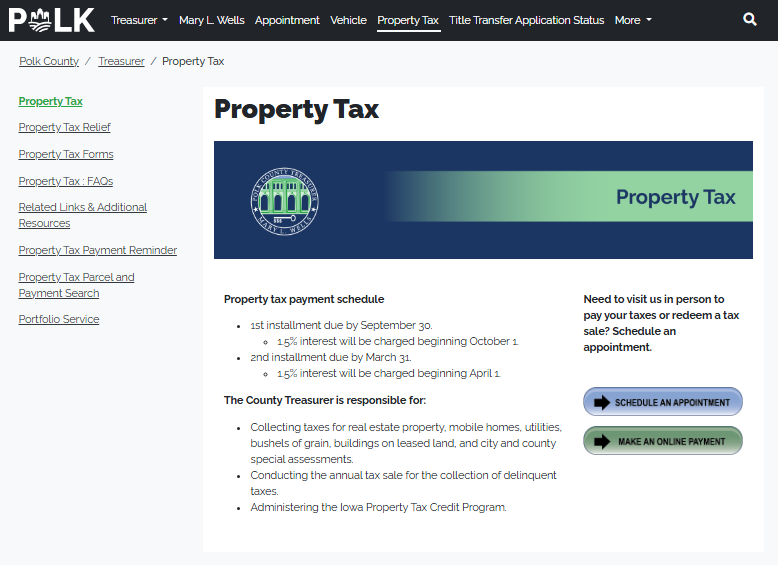
Property taxes in Polk County, Iowa, are billed twice annually. The first installment is typically due on September 30, covering half of the yearly tax amount. The second installment is due on March 31 of the following year, completing the annual payment. If a payment is made after these dates, interest begins accruing the next day, calculated daily until the amount is fully paid.
Polk County Property Tax Calendar
| Installment | Due Date | Notes | Interest Trigger |
|---|---|---|---|
| First | September 30 | Covers 50% of annual tax | October 1 |
| Second | March 31 | Covers remaining 50% | April 1 |
Homeowners can check their exact amounts and parcel information using the county’s tax lookup tools. These tools also provide reminders and help confirm if payments have been received. Keeping track of deadlines ensures that residents avoid additional fees or interest.
How to Pay Online or In Person
Residents have multiple payment options:
- https://www.iowataxandtags.org/

- Online Payments: Polk County offers a secure online portal for full or installment payments. Credit, debit, and e-checks are accepted.
- In-Person Payments: Payments can be made at the Treasurer’s Office (123 E. Grand Avenue, Des Moines, IA 50309) during business hours.
- Drop Box: A secure drop box is available for checks or money orders outside the office.
- Mail: Payments sent by mail must be postmarked by the due date to avoid interest.
Using the online portal or setting up reminders can help avoid late submissions. Residents can also save receipts electronically for proof of payment.
Avoiding Late Fees and Interest
Late or partial payments immediately start accruing interest, which increases daily. The county calculates interest on the unpaid balance, making timely payments cost-effective.
Some tips to avoid extra charges include:
- Set calendar reminders before September 30 and March 31.
- Consider automatic payments through the online portal.
- Verify payment via the Polk County tax lookup tool.
- Contact the Treasurer’s Office for questions about installment calculations.
These steps can prevent penalties and ensure property owners stay in good standing. Regularly checking amounts and using official county resources simplifies planning and reduces stress around property taxes.
Property Tax Relief Programs
Polk County offers several property tax relief programs to reduce the financial burden on eligible residents. These programs include the Senior and Disabled Homeowners Credit and special rates for mobile or manufactured homes https://www.polkcountyiowa.gov/treasurer/property-tax/property-tax-relief/. These programs help residents lower their Polk County, Iowa, property taxes by providing exemptions or reduced rates based on age, disability, or property type. The Polk County, Iowa, Tax Assessor manages these programs and ensures applicants meet all criteria.
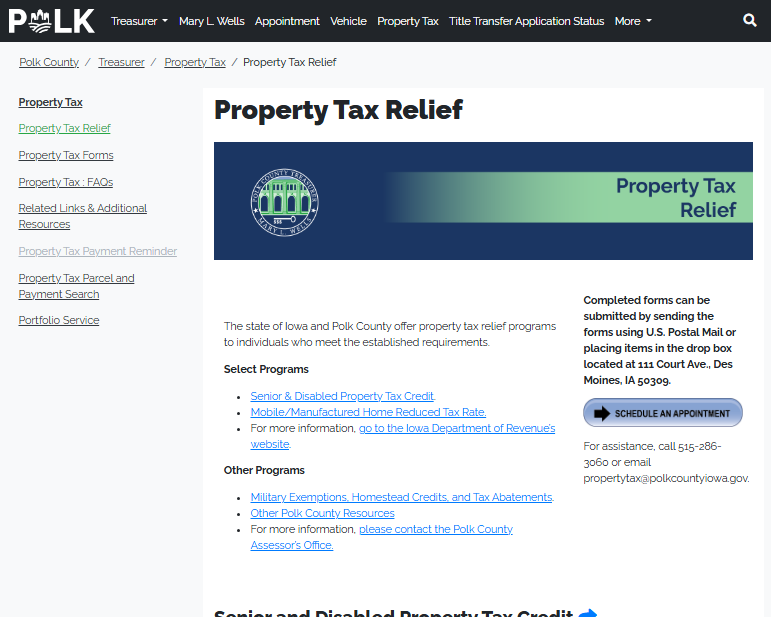
Senior & Disabled Homeowners Credit
The Senior and Disabled Homeowners Credit allows qualifying individuals to receive a reduction in property taxes. https://revenue.iowa.gov/ Seniors aged 65 or older and residents with qualifying disabilities can apply to lower their annual tax bill. This program works alongside the homestead exemption to provide additional financial relief.
Eligible homeowners may see a significant decrease in taxes depending on their income and the assessed value of their property. The credit is calculated annually and automatically applied once approved. Many residents rely on this program to maintain home affordability.
Eligibility Table: Senior & Disabled Homeowners Credit
| Criteria | Requirement | Notes |
|---|---|---|
| Age | 65 or older | Or permanently disabled |
| Income | Household income ≤ $45,000 | Includes Social Security and pensions |
| Property | Must be primary residence | Excludes rental or investment properties |
| Application | File annually with assessor | Late filings may reduce credit |
Mobile/Manufactured Home Tax Rate
Mobile and manufactured homes in Polk County may qualify for a reduced property tax rate. These rates are generally lower than standard residential property rates. The county uses a different assessment method for these homes to ensure fair taxation. Owners must ensure their homes are properly registered with the assessor and that the property remains in Polk County. The reduced rate helps residents manage costs, especially for those on fixed incomes or living in smaller homes.
Filing Instructions and Deadlines
Residents applying for tax relief must submit forms directly to the Polk County, Iowa, Tax Assessor. Applications typically require proof of age, disability status, income documentation, and property details.
Deadlines and filing tips include:
- Annual filing: Submit by March 1 to receive credit for the current tax year.
- Supporting documents: Include Social Security statements, medical disability verification, or income statements.
- Assistance: The assessor’s office can provide forms and answer questions during business hours.
Applying early ensures timely processing and prevents missed opportunities for tax reduction. Residents can combine multiple exemptions, such as homestead and military exemptions, for additional savings.
Parcel Search and Official Records
Polk County property owners can quickly check tax amounts, ownership, and history using the official assessor tools and public works resources. These online resources provide accurate property records and streamline the process of reviewing taxes and related public works information. The Polk County, Iowa, Tax Assessor maintains a searchable database that lets residents view detailed property information. Users can perform a parcel search to find ownership data, assessed values, property history, and updates connected to public works projects.
Each property record includes:
- Legal description of the property
- Current owner and mailing address
- Assessed value and taxable value
- Tax levy and payment history
- Previous sale dates and prices
Property owners can search by parcel number, owner name, or address. This flexibility helps residents verify that tax bills reflect accurate property details. Additionally, the system updates regularly to ensure the records are reliable for official and personal use.
How to Confirm Billing & Past Payments
Property owners can review current and past tax bills directly through the online portal. The system displays payment history, due dates, and outstanding balances. To confirm a payment, users can:
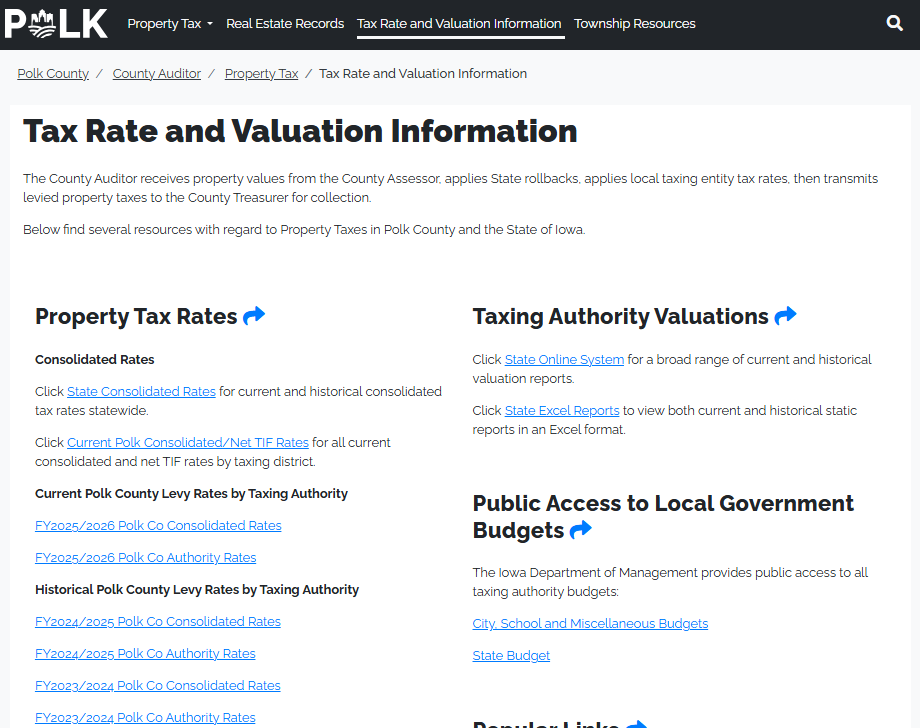
- https://www.polkcountyiowa.gov/county-auditor/property-tax/tax-rate-and-valuation-information/
- Enter the parcel number or owner name in the search field.
- Click on the property record to view detailed billing information.
- Check the status of each tax installment, including prior years.
This feature reduces the chance of missed payments or errors. It also helps property owners verify whether payments made by mail or at the counter have been recorded accurately.
Printing Receipts & Documentation for Taxes
The Polk County assessor portal allows residents to generate official documentation for tax payments. Receipts can be printed or saved as PDFs for personal records, loan applications, or legal purposes.
Points include:
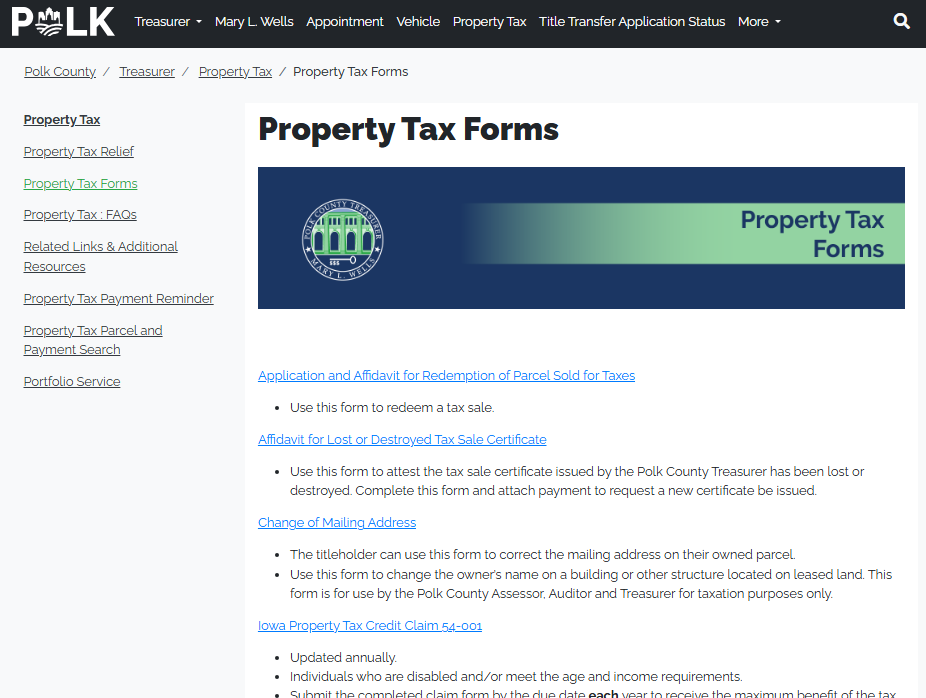
- https://www.polkcountyiowa.gov/treasurer/property-tax/property-tax-forms/
- Select the desired tax year from the property record.
- Choose the “Print Receipt” or “Download PDF” option.
- Keep digital or physical copies for future reference.
These tools ensure that all tax-related documents are easily available without visiting the office. By combining parcel search with secure documentation, property owners can manage taxes efficiently and maintain accurate records.
Special Situations: Tax Sales & Redemptions
Polk County residents with unpaid property taxes face a legal process that can lead to tax sales. Property owners have a chance to reclaim their parcels through redemption before permanent ownership transfers.
Delinquent taxes, tax sales, and redemption rights are crucial for property owners. When property taxes in Polk County remain unpaid, the county may list the property in the annual tax sale, offering investors the opportunity to purchase liens on these delinquent parcels. This process ensures that the county collects owed revenue while giving owners a way to resolve their debts.
Annual Tax Sale Process
The annual tax sale in Polk County occurs when parcels with unpaid property taxes are auctioned to recover delinquent amounts. Here’s how it works:
- Delinquent Notice: Property owners are notified if taxes remain unpaid.
- Listing for Sale: The Polk County Treasurer publishes a list of delinquent parcels.
- Auction Event: Investors bid on the tax liens, paying the owed taxes and receiving a certificate.
- Interest Accrual: Certificates earn interest, often a percentage set by law, until redeemed.
Property owners can avoid permanent loss by paying the owed amount plus interest and fees, keeping ownership intact. The tax sale does not immediately transfer ownership but creates a lien that the purchaser can later enforce.
Redeeming Sold Parcels
Redemption allows the original owner to reclaim a sold parcel before full foreclosure. The steps for redemption in Polk County include:
- Calculate Total Owed: Include delinquent taxes, fees, and interest accrued from the date of sale.
- Obtain Redemption Affidavit: The Polk County Treasurer provides a redemption affidavit to start the process.
- Submit Payment: Pay the full amount owed at the Treasurer’s office or through approved channels.
- Receive Confirmation: The Treasurer issues a certificate confirming the redemption, clearing the tax lien.
Owners typically have two years from the date of the sale to redeem the property. During this period, investors cannot take ownership, but they retain the right to collect interest.
Managing Multiple Properties
Managing multiple properties in Polk County requires organization and consistent tracking of property tax obligations. Owners with several parcels can save time and avoid penalties by using simple systems and tools.
Property owners with multiple parcels face unique challenges when paying Polk County, Iowa, property taxes. Keeping track of due dates, tax amounts, and property records can become overwhelming without a clear method. A practical approach begins with creating a property checklist for all parcels. Include details like parcel numbers, assessed values, payment deadlines, and contact information for the Polk County, Iowa, Tax Assessor. This helps consolidate all essential data in one place.
For Efficient Management:
- Use a Calendar: Mark key tax deadlines for each property, including payment and appeal dates. Digital calendars with alerts work best.
- Organize Documents: Maintain separate folders for each property—physical or digital. Include deeds, assessments, and correspondence.
- Set Reminders: Schedule reminders before each tax due date to avoid late fees. Include reminders for any updates in property records.
- Track Payments: Keep a record of past and upcoming payments to monitor your portfolio and prevent missed deadlines.
For those managing a larger portfolio, consider creating a master spreadsheet with columns for:
| Parcel Number | Property Address | Assessed Value ($) | Tax Amount ($) | Due Date | Payment Status | Notes / Updates |
|---|---|---|---|---|---|---|
| 123456 | 101 Main St, Des Moines | 250,000 | 4,500 | 3/31/2026 | Paid | Homestead exemption applied |
| 123457 | 205 Oak Ave, Des Moines | 180,000 | 3,200 | 3/31/2026 | Pending | Appeal filed for assessed value |
| 123458 | 309 Pine St, Clive | 320,000 | 5,800 | 3/31/2026 | Paid | New improvements added |
| 123459 | 412 Maple Dr, Urbandale | 150,000 | 2,700 | 3/31/2026 | Pending | Mobile/manufactured home rate applied |
| 123460 | 523 Cedar Ln, Ankeny | 400,000 | 7,200 | 3/31/2026 | Paid | Check for updated parcel map |
This provides a clear overview and simplifies tax lookup through the Polk County online resources. Maintaining such a system also streamlines the process if you need to verify ownership, assess new property values, or track changes in property records.
How Assessments, Credits, and Rates Shape Your Bill
Polk County, Iowa, property taxes are determined by a combination of assessed value, applicable exemptions and credits, and the tax rates set by local authorities. Each step—from the Assessor to the Auditor to the Treasurer—directly influences the final amount a property owner pays.
The Assessor Sets the Value
The Polk County Assessor evaluates each property to establish its assessed value, which is the basis for taxation. This valuation considers:
- Land value: the worth of the plot itself
- Improvements: structures, additions, or renovations
- Comparable sales: recent sales of similar properties in the area
Property owners may qualify for exemptions such as a homestead or veteran exemptions, which reduce the taxable value. For example, a home with a $200,000 assessed value and a $50,000 homestead exemption would have $150,000 subject to tax.
Auditor Calculates Taxes
Next, the Polk County Auditor applies the local tax rates to the assessed value. Rates differ based on districts, schools, and special levies. The Auditor also applies tax credits, including:
- Senior and Disabled Property Tax Credit
- Mobile/manufactured home reduced rate
Here’s a sample calculation for clarity:
| Item | Amount | Notes |
|---|---|---|
| Assessed Value | $200,000 | From Assessor |
| Homestead Exemption | $50,000 | Reduces taxable value |
| Taxable Value | $150,000 | After exemptions |
| Local Tax Rate | 2.5% | Combined city, county, and school rate |
| Tax Before Credits | $3,750 | $150,000 × 2.5% |
| Senior Credit | $500 | Applied to eligible residents |
| Final Tax Bill | $3,250 | Amount owed to Treasurer |
Treasurer Issues the Bill
Finally, the Polk County Treasurer generates the official tax bill and handles payments. Property owners can pay online, by mail, or in person. The Treasurer’s office also records payment history and manages penalties for late payment.
By following these steps, property owners can see exactly how exemptions, credits, and rates combine to determine their final bill. Awareness of each stage helps homeowners plan their finances and ensures they benefit from all eligible reductions.
Leveraging County Services Beyond the Tax Bill
Polk County residents can use county services to simplify property management and support tax filing. These resources provide official documentation, forms, and payment records that go beyond just paying the property tax bill. The Polk County Iowa, Tax Assessor and other county offices offer tools that help property owners maintain accurate records. Property owners can access official forms and documents needed for income tax deductions, verify ownership, or confirm legal descriptions. This documentation is particularly useful for income tax filing, refinancing, or legal purposes.
Accessing Key Records and Forms
County offices provide several essential services for property management:
- Assessor Forms: Property owners can find assessment details, homestead exemptions, and tax credit forms.
- Auditor Real Estate Records: These records show ownership history, legal descriptions, and parcel details.
- Treasurer Payment History: Complete payment history for property tax payments helps in tax reporting or verifying balances.
Using these services ensures that property records remain accurate, reduces errors in filing, and helps claim proper deductions on income taxes.
How These Services Support Tax Reporting
Having organized tax documentation is crucial for reporting property taxes on federal or state returns. County-provided forms can confirm:
- Legal Description of Property: Required for tax forms or legal transactions.
- Payment Verification: Helps substantiate property tax payments for deductions.
- Homestead and Credit Applications: Ensures eligibility for tax relief programs.
By keeping updated records from the Polk County, Iowa, Tax Assessor, Treasurer, and Auditor, property owners maintain proper documentation. These services complement the tax bill, providing accurate, official records that can support financial and legal needs efficiently.
Departments and Office Contacts
Polk County residents can reach key offices directly for property tax questions, payments, or records. The Assessor, Auditor, and Treasurer offices provide reliable services and official contacts for property-related matters.
These county offices handle property valuations, tax collection, and official recordkeeping. The Polk County Assessor determines property values for tax purposes, while the Auditor manages property tax records and election-related duties. The Treasurer handles payments and refunds and provides multiple payment options for residents. Contacting the right office ensures prompt service and accurate information.
Below is a concise directory of key Polk County offices, including addresses, phone numbers, and regular office hours:
| Office | Address | Phone | Hours |
|---|---|---|---|
| Assessor | 111 Court Ave, Room 110, Des Moines, IA 50309 | (515) 286-3080 | Mon–Fri: 8:00 AM – 4:30 PM |
| Auditor | 111 Court Ave, Room 230, Des Moines, IA 50309 | (515) 286-3085 | Mon–Fri: 8:00 AM – 4:30 PM |
| Treasurer | 111 Court Ave, Room 115, Des Moines, IA 50309 | (515) 286-3087 | Mon–Fri: 8:00 AM – 4:30 PM |
Residents can handle tasks like verifying ownership, reviewing tax assessments, and making payments by calling or visiting these offices. Each office maintains official records that are crucial for property tax purposes. County office staff can also provide forms, schedules, and instructions for property tax procedures.
(FAQs) About Polk County Property Tax
Property owners in Polk County can check parcel balances, pay taxes online, and explore relief programs through official county tools. Filing exemptions and calculating interest on unpaid taxes is straightforward if residents follow county procedures carefully.
How to Check Parcel Balance?
Residents can use the Polk County tax lookup to view current balances, due dates, and payment history. Enter the property address, owner name, or parcel number in the parcel search tool to get detailed information. This helps homeowners track taxes accurately, plan payments, and avoid late fees. Accessing parcel details online is fast and provides official documentation for personal records.
Paying Property Taxes Online?
Property taxes can be paid online via the Polk County portal using credit/debit cards or e-checks. Payments are processed immediately, and receipts can be printed for records. Users can schedule payments in advance to meet deadlines. In addition to online options, residents may pay in person, by mail, or via county drop boxes for convenience.
Eligibility for Relief Programs?
Polk County offers a Senior and Disabled Property Tax Credit and reduced rates for mobile/manufactured homes. Seniors 65+ and certified disabled residents may qualify for credits on homestead properties. Mobile home owners can apply for a lower rate regardless of age. Applications must be submitted to the Assessor’s Office within the annual deadlines to receive the benefit.
Interest Calculation?
Late property tax payments accrue interest each month at a rate set by Iowa law, with penalties possibly added. For example, a $2,000 unpaid balance at 1% monthly interest would generate $20 in interest for the first month. Timely payments help residents avoid additional charges and keep accounts in good standing with the county.
Filing Exemptions?
Exemptions like homestead, veterans, and agricultural exemptions reduce taxable property value. Residents must submit applications to the Assessor’s Office along with proof of eligibility, such as age, disability, or veteran status. Meeting county deadlines ensures the exemption applies to the current tax year and lowers overall property tax owed.