The Polk County Medical Examiner conducts professional investigations for deaths that are sudden, unexpected, or legally sensitive. The office provides forensic examinations, prepares detailed autopsy reports, and maintains official death records used by law enforcement, courts, and families. Its team applies scientific methods to determine the cause and manner of death, supporting criminal investigations, insurance claims, and public safety measures. Every case receives careful documentation, including evidence collection, toxicology testing, and postmortem analysis, ensuring accuracy and reliability.
This office also serves as a central authority for certified death records in Polk County, offering secure documentation for legal, administrative, and family needs. Staffed by trained forensic pathologists and support personnel, the Medical Examiner’s office works with law enforcement, hospitals, and emergency responders to manage investigations efficiently. It provides clear, legally recognized autopsy reports that can be used in court proceedings or official reviews. By combining forensic science with detailed recordkeeping, the office plays a critical role in public health and safety, supporting the community through reliable death investigations and authoritative documentation.
What Does the Polk County Medical Examiner Do?
The Polk County Medical Examiner investigates deaths that occur under unusual or suspicious circumstances to determine the cause and manner of death. This office ensures that each case is examined thoroughly, https://www.polkcountyiowa.gov/medical-examiner/what-does-the-polk-county-medical-examiners-office-do/ supporting legal processes, public safety, and families seeking clarity. The Medical Examiner’s role combines science, law, and public service. Using forensic pathology, the office examines decedents, reviews medical histories, and may order autopsies or toxicology tests. Findings help law enforcement determine criminal liability, assist in insurance and legal claims, and provide essential data for health and safety trends in the county.
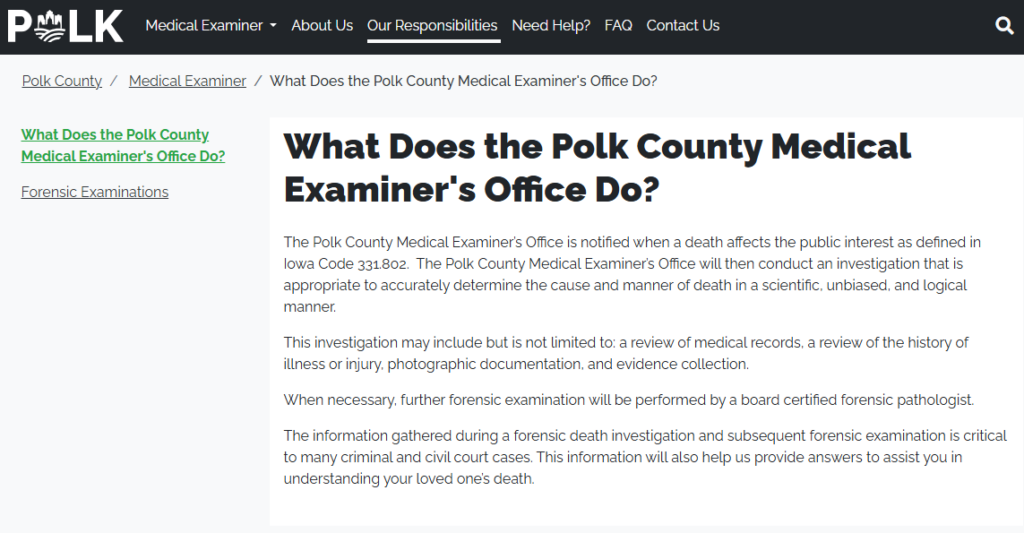
Public-Interest Mandate – Iowa Code 331.802
Under Iowa Code 331.802, the Polk County Medical Examiner conducts medicolegal death investigations when a death is sudden, unexpected, or unattended. This law defines situations that trigger investigation, including:
- Deaths without a physician in attendance
- Suspicious or violent deaths
- Deaths in custody or under state supervision
- Deaths possibly linked to public hazards, such as accidents or overdoses
These investigations help protect public safety and maintain accurate cause of death records. Each case is documented carefully, and findings may be used in court proceedings or for public health reporting. The legal framework ensures transparency and accountability in death examinations.
Scope of Cases
The Polk County Medical Examiner reviews a wide variety of cases. Common examples include:
- Unattended deaths – individuals who pass away without immediate medical supervision
- Accidental deaths – falls, motor vehicle collisions, or other unexpected incidents
- Deaths in custody – deaths occurring in jail, prison, or law enforcement settings
- Suspected overdoses – cases involving drugs or toxic substances
- Homicide and suicide – deaths requiring full forensic investigation
A forensic pathologist evaluates the death circumstances, using autopsies, lab testing, and scene information. The goal is to establish a clear record of events and provide families, law enforcement, and courts with accurate, reliable information.
When and How the Office Is Notified
The Polk County Medical Examiner is notified whenever a death occurs under circumstances that require investigation, including sudden, unexpected, or unattended deaths. Notifications can come from hospitals, law enforcement, EMS, long-term care facilities, or even community members. The notification process is designed to ensure that deaths are investigated properly, preserving evidence and complying with legal requirements. Any person who suspects a death may fall under the medical examiner’s jurisdiction is encouraged to report it immediately. Prompt reporting helps protect public health, maintain accurate records, and support potential legal proceedings.
Notification Sources: Hospitals, Long-Term Care, EMS, Law Enforcement, Community Members
Several entities regularly notify the medical examiner’s office:
- Hospitals and Clinics: Medical staff report deaths that are sudden, unexplained, or involve legal concerns.
- Long-Term Care Facilities: Nursing homes alert the office if a resident dies unexpectedly or under suspicious conditions.
- Emergency Medical Services (EMS): Paramedics and first responders notify the office of deaths occurring at home, in transit, or at accident scenes.
- Law Enforcement: Police and sheriff’s departments report deaths related to accidents, crimes, or unattended circumstances.
- Community Members or Family: Legal next of kin or witnesses may contact authorities when a death occurs outside a medical facility.
These notifications are logged systematically, including the deceased’s name, time of death, location, and any immediate observations. This record supports the chain of custody and ensures that investigators have accurate information for legal and forensic purposes.
Time-Sensitive Investigations: Importance of Rapid Scene Response
Once notified, the medical examiner’s team often responds quickly to preserve evidence and document the scene. Rapid response is critical for cases involving potential foul play, accidents, or public health concerns. Delays can compromise forensic standards, including evidence collection, toxicology samples, and documentation of injuries.
- Scene Documentation: Photos, measurements, and observations are taken immediately.
- Evidence Collection: Items that could help determine the cause of death are preserved according to legal protocols.
- Chain of Custody: Maintaining records ensures all evidence remains admissible in court if needed.
- Collaboration: The office coordinates with law enforcement, EMS, and hospitals to complete thorough investigations efficiently.
A study by the National Association of Medical Examiners notes that prompt notifications reduce errors and improve accuracy in cause-of-death determinations. Quick reporting also ensures families receive timely information and supports any legal or insurance processes.
The Investigation Process
Polk County death investigations focus on determining the cause and manner of death accurately and quickly. This process combines thorough scene examination, medical review, and forensic analysis to support legal, public health, and family needs.
Initial Assessment: Identity, Scene Documentation, Collecting Medical History
The first step in any death investigation is identifying the deceased and documenting the scene. Investigators record the location, surrounding evidence, and any conditions that might have contributed to the death. They also collect medical history, witness statements, and prior health records to provide context for the investigation.
Elements include:
- Forensic documentation: Photographs, notes, and diagrams of the scene.
- Investigative procedures: Collecting personal items, clothing, and environmental evidence.
- Identification: Confirming identity using official records, fingerprints, or dental information.
These steps ensure a clear baseline for the investigation and help prevent errors in later stages. Accurate scene documentation supports both legal proceedings and public records.
Autopsy Authorization & Procedures: Board-Certified Forensic Pathologist Role
Once the initial assessment is complete, the autopsy process begins under a board-certified forensic pathologist. Authorization may come from legal authorities, next of kin, or, in cases required by law. The pathologist examines the body internally and externally, documenting injuries, disease, and other physical conditions.
Important procedures include:
- Postmortem examination: Thorough internal inspection to identify trauma, disease, or toxins.
- Autopsy reports: Detailed findings that summarize medical and forensic observations.
- Laboratory testing: Blood, tissue, and fluid analysis for drugs, chemicals, or pathogens.
This stage provides objective, medically verified evidence to support official records and potential legal investigations. Pathologists also collaborate with law enforcement to ensure evidence is preserved properly.
Determining Cause & Manner of Death: How Findings Inform Public Health, Legal, and Vital Records
The final step is analyzing all collected information to determine the cause and manner of death. Cause of death refers to the specific injury or disease that led to death, while manner classifies it as natural, accidental, homicide, suicide, or undetermined.
- Forensic analysis links physical findings with medical history and investigative data.
- Public health relevance: Patterns in deaths may inform disease tracking or safety measures.
- Legal documentation: Provides evidence for court cases, insurance, or governmental reporting.
Accurate determination is critical for death certificates, family closure, and law enforcement investigations. Each finding contributes to vital records and helps maintain community safety.
Core Values and Independence of the Office
The Polk County Medical Examiner operates with professionalism, integrity, and empathy, ensuring every case receives objective, evidence-based attention. Independence is a cornerstone of the office, maintaining public trust and legal credibility in all investigations.
The office follows strict core values that guide its daily operations:
- https://www.polkcountyiowa.gov/medical-examiner/about-us/mission-statement/
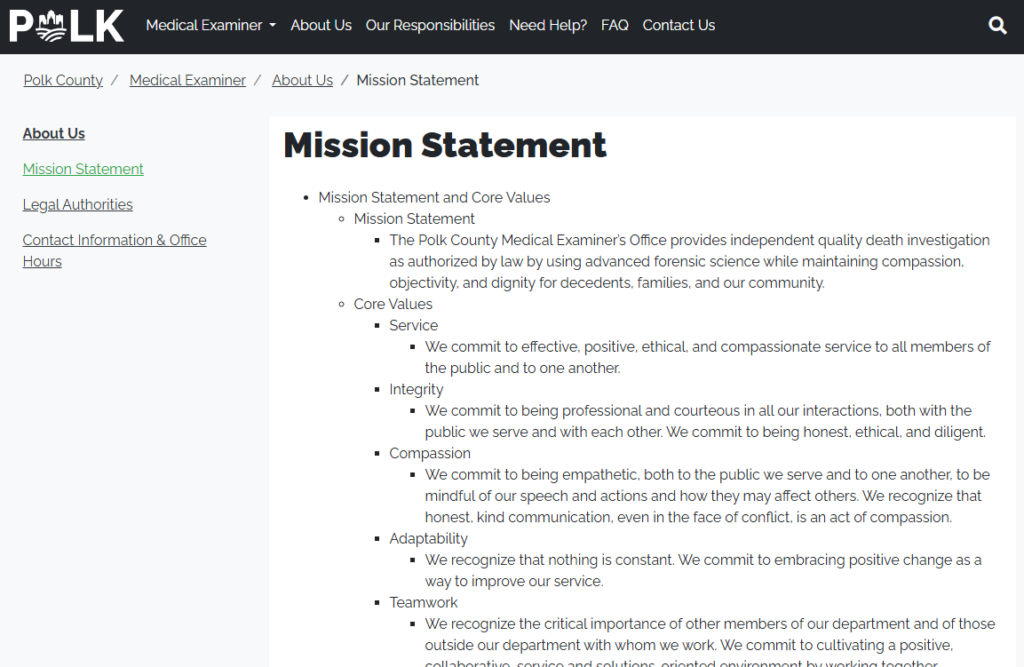
- Professionalism: Each investigation is handled with the highest standard of conduct, respecting both the deceased and their families.
- Objectivity: Findings rely solely on evidence and scientific methods, free from external influence.
- Integrity: Honest reporting and ethical behavior are fundamental, ensuring all conclusions are accurate and defensible.
- Empathy: Staff approach each case with compassion, recognizing the emotional impact on families and the community.
Independence allows the medical examiner to provide impartial results that courts, law enforcement, and the public can trust. By relying on scientific methods and thorough analysis, the office produces evidence-based conclusions that withstand scrutiny in legal and investigative settings.
Requesting Autopsy and Death Records
Polk County residents and authorized representatives can request autopsy and death records, including vehicle registration details when applicable, directly from the Medical Examiner’s Office. Requests are processed carefully to protect privacy while providing access to those with legal or professional authority.
Who Can Request – Legal Next of Kin, Attorneys, Researchers
Access to Polk County Medical Examiner records is limited to specific parties. Legal next of kin, authorized attorneys, and approved researchers may submit requests, depending on the purpose. These records are considered confidential, and staff verify identity and eligibility before releasing any information.
- https://www.polkcountyiowa.gov/media/msmdxit1/pcme-autopsy-request-form-6-25-25.pdf
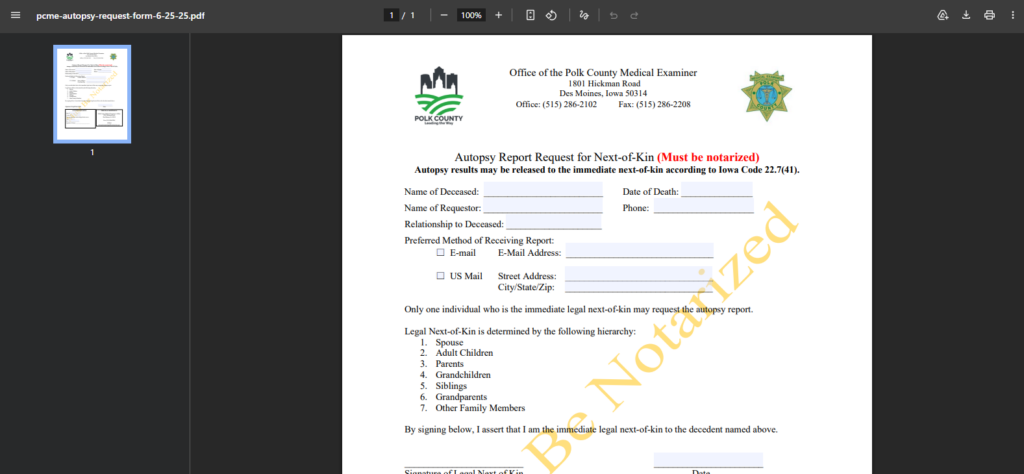
- Legal Next of Kin: Spouses, children, parents, or legally recognized relatives may request records for personal, legal, or estate purposes.
- Attorneys: Legal representatives can request records on behalf of clients, often for litigation or investigative purposes.
- Researchers: Academic or scientific research requests are limited and must follow strict approval procedures to protect privacy.
Each request requires documentation proving eligibility. Personal identification and proof of relationship or authorization are typically requested.
Steps – Forms, Submission, Timelines, Fees
Requesting autopsy and death records involves a clear process that helps manage expectations.
- https://www.polkcountyiowa.gov/medical-examiner/
- Complete the Request Form: Obtain the official form from the Polk County Medical Examiner website or office.
- Provide Required Documentation: Include identification, proof of relationship, or an authorization letter if applicable.
- Submit the Request: Forms can often be submitted by mail, in person, or occasionally online. Check the office for current submission options.
- Processing Time: Typical processing ranges from 2–6 weeks, depending on request volume and completeness of the form.
- Fees: A standard fee may apply for copies of records, particularly for certified documents. Contact the office for current costs.
Records include detailed autopsy reports, findings, and death information. Staff may contact requesters if additional verification is needed.
Outside Polk County – Directing Users to Statewide Medical Examiner Contact
For deaths that occurred outside Polk County, the Iowa Office of the State Medical Examiner handles requests. Jurisdiction matters, as the local office only maintains records for incidents investigated within Polk County.
- Residents or professionals seeking records from other counties should contact the statewide office directly.
- The State Medical Examiner can provide guidance on forms, fees, and processing timelines.
By following these procedures, families, attorneys, and approved researchers can obtain access to necessary records while maintaining compliance with state privacy laws and regulations.
What Families Can Expect After a Death
After a death, families in Polk County can expect professional support from the medical examiner’s office. The team provides clear communication, care for the decedent, and guidance through legal and investigative steps.
Initial Contact & Information Gathering
When a death occurs, the Polk County Medical Examiner’s staff contacts the next of kin to collect essential information. Families will be asked about the decedent’s medical history, medications, and the circumstances surrounding the death. This step ensures a thorough review and helps determine whether further investigation is needed. Staff approach these conversations with dignified communication, offering explanations without overwhelming families. Key points typically covered include:
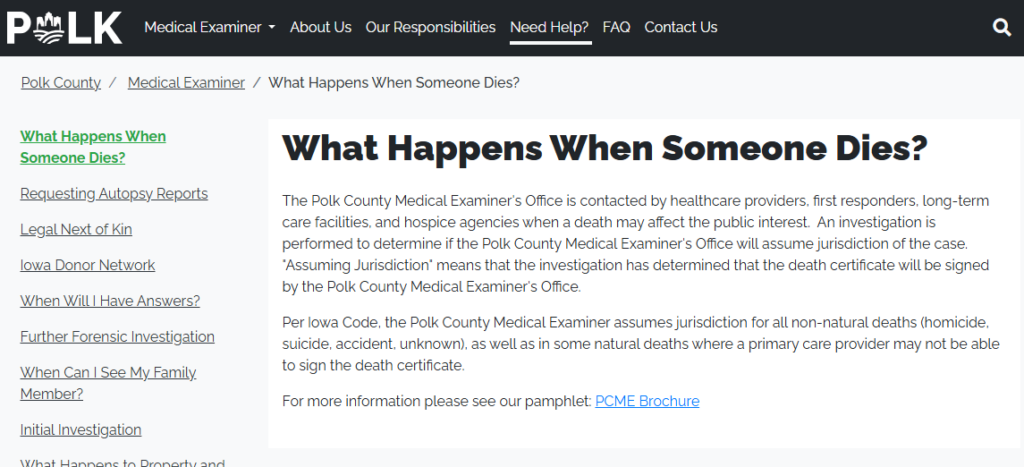
- https://www.polkcountyiowa.gov/medical-examiner/what-happens-when-someone-dies/
- Full name, age, and personal details of the decedent
- Recent health conditions or treatments
- Circumstances of the death, including location and timing
- Witnesses or persons present at the time of passing
These questions help the office complete legal documentation, support any ongoing investigations, and provide families with a clear understanding of next steps.
Transportation & Examination Process
Once initial information is collected, the decedent is carefully transported to the medical examiner’s facility. Decedent care follows strict standards to ensure the body is treated respectfully and handled safely.
Families can expect that:
- The body is transported discreetly and securely
- Examinations are conducted professionally to determine the cause of death
- Any necessary procedures, such as an autopsy, are explained to families beforehand
This process allows the office to fulfill legal and investigative responsibilities while maintaining compassion for grieving families. The medical examiner team coordinates closely with funeral homes if families plan immediate arrangements.
Communication During Investigation
Families receive ongoing updates throughout the investigation. While timelines can vary based on case complexity, the office prioritizes clear and empathetic communication.
Families are informed about:
- Status of the examination or autopsy
- Any additional testing or external consultations
- Documentation required for legal or insurance purposes
Staff provide support and, without pressure, help families feel informed and respected during a challenging time. Maintaining family and transparency is central to the office’s approach, ensuring trust and reassurance.
Collaboration With Justice and Health Systems
The Polk County Medical Examiner works closely with law enforcement, EMS, prosecutors, and public health agencies to ensure accurate forensic analysis. This collaboration helps guide criminal investigations, civil cases, and public health decisions efficiently.
Effective Polk County forensic collaboration begins with clear communication and shared procedures. The Medical Examiner’s office receives case referrals from police and EMS, maintaining the chain of custody for all evidence. This ensures that all samples, reports, and findings are legally admissible and can support both criminal and civil proceedings.
Coordination With Law Enforcement and Prosecutors
The Medical Examiner provides timely information that supports investigations and prosecutions. Autopsy findings, toxicology reports, and forensic analyses help detectives and prosecutors understand causes of death, confirm timelines, and evaluate evidence. By integrating evidence synthesis methods, the office ensures that all details are presented clearly and accurately for case preparation.
Collaboration points include:
- Reviewing forensic evidence with detectives and crime scene investigators
- Sharing toxicology and autopsy results with prosecutors for case strategy
- Advising on the medical aspects of suspected criminal acts
Partnership With EMS and Public Health
The Medical Examiner also works with EMS teams to track emergency response data and incident patterns. This partnership improves response protocols and identifies trends that affect community safety. Public health departments rely on the Medical Examiner for statistical reporting on causes of death, trends in accidents, and potential disease outbreaks.
Benefits of this collaboration:
- Supports public safety and community health initiatives
- Enables faster, more accurate criminal and civil investigations
- Provides data for statistical analysis and policy planning
By following a multidisciplinary approach, the Polk County Medical Examiner ensures that forensic findings are integrated into the broader justice and health systems. This collaboration strengthens trust in legal outcomes and contributes to safer, more informed communities.
Scientific Methods Supporting Accurate Findings
The Polk County Medical Examiner relies on precise forensic science methods to ensure accurate conclusions in every investigation. From careful scene assessment to advanced laboratory testing, each step strengthens the validity of their findings.
Scene Assessment and Evidence Collection
The process begins at the location of an incident. Forensic experts document the environment, photograph relevant details, and carefully collect physical evidence.
Evidence may include:
- Biological samples such as blood or tissue
- Trace materials like fibers or hair
- Weapons or objects related to the incident
Collected items are preserved under strict protocols to maintain integrity. This systematic approach supports unbiased conclusions and helps avoid contamination that could affect postmortem testing.
Laboratory Analysis and Toxicology
Once evidence reaches the lab, the medical examiner’s team conducts thorough analyses. Toxicology testing identifies the presence of drugs, alcohol, or other substances that may have contributed to a death. Microscopic examination reveals cellular or tissue changes that indicate disease, trauma, or environmental effects. These methods are a core part of Polk County forensic science, combining accuracy with scientific rigor.
Forensic Pathologist Review
All findings are reviewed by board-certified forensic pathologists. These specialists assess the evidence using established forensic methodology to ensure objective results. Their expert interpretation is essential for forming a comprehensive report that stands up in legal and medical contexts.
Integration of Methods for Reliable Results
By combining scene documentation, evidence collection, lab testing, and expert review, the Medical Examiner’s office ensures high-quality results. Each step supports another, creating a chain of evidence that delivers confidence in cause-of-death determinations. This thorough, structured process makes Polk County’s forensic investigations reliable and credible for families, law enforcement, and the courts.
Location, Hours, and Accessibility
The Polk County Medical Examiner’s Office is located in Des Moines, IA, and is available 24/7 for investigations and emergencies. Administrative inquiries can be handled during regular office hours at the main facility.
The office is situated to provide prompt response to all public safety needs and is easily reachable for law enforcement, legal professionals, and families requiring information. 24/7 coverage ensures that on-call investigators can respond to unattended deaths, suspicious circumstances, or sudden fatalities at any time. For non-emergency matters, the office maintains standard administrative hours, allowing the public to contact staff for records, reports, or general inquiries.
Office Address and Contact Details:
| Detail | Information |
|---|---|
| Location | 1907 Carpenter Avenue, Des Moines, IA 50316 |
| Phone | (515) 286-2100 |
| Administrative Hours | Monday–Friday: 8:00 AM – 4:30 PM |
| Emergency / On-Call Investigators | 24/7 availability |
Public access is structured to respect privacy and safety, with clear procedures for visiting, submitting inquiries, or requesting records. Emergency contact protocols ensure law enforcement agencies can coordinate quickly with medical examiners during active investigations. The office also maintains on-call investigators who can provide timely assessments at accident sites or residences, helping authorities collect evidence efficiently.
(FAQs) About Polk County Medical Examiner
The Polk County Medical Examiner handles cases based on legal and investigative jurisdiction. Families and authorities can contact the office to understand release procedures, autopsy timelines, and access policies.
Who Determines Jurisdiction?
Jurisdiction is determined by the circumstances of death and legal authority. The Medical Examiner has authority when a death is sudden, suspicious, unattended, or involves criminal activity. Local law enforcement, hospitals, or families may notify the office, but the final decision rests with the Medical Examiner’s office following state law. This ensures that every investigation meets legal and investigative standards.
When and How is a Decedent Released?
Decedents are released after the Medical Examiner completes the examination and any necessary testing. Families or funeral homes must submit proper identification and paperwork, including a death certificate request. Release times vary, but typically occur once all autopsy procedures and documentation are finalized. Some cases may require additional coordination with law enforcement or courts if further investigation is ongoing.
How Long for Autopsy Reports?
Autopsy reports in Polk County generally take 2–6 weeks to complete, depending on the complexity of the case. Cases involving toxicology or specialized testing may take longer. The report includes findings, the cause of death, and relevant investigative details. These timelines align with state investigative standards and help provide accurate information for families and authorities.
Viewing or Family Access Policies
Family members can request information or limited viewing under strict protocols. The Medical Examiner’s office prioritizes privacy and compliance with vital records regulations. Only immediate family or legally authorized representatives can access certain documents or arrange to view the decedent, and appointments are required. Staff provide paperwork, identification, and any legal requirements for family access.
Can Families Request Copies of Autopsy or Death Records?
Yes, families or legal representatives can request copies of autopsy or death records from the Polk County Medical Examiner. Requests must include proof of relationship, valid identification, and a completed request form. Certain sensitive information may be redacted to comply with vital records laws and investigative standards. Copies are typically provided in a secure format, either printed or electronically, and fees may apply depending on the type of record requested.