The Polk County, Iowa, Assessor determines accurate property values for all residential, commercial, and industrial parcels in the county. This office maintains detailed assessor records, including ownership history, improvements, and property characteristics, ensuring fair taxation. Residents can access official parcel info online or through the office to verify property details, track changes, and confirm assessments for their homes or businesses. Clear and up-to-date assessments help maintain consistency across property taxes and support transparency in the local community.
The Assessor’s office also provides tools for reviewing property values and filing assessment inquiries or corrections efficiently. Digital resources allow users to explore maps, historical valuations, and detailed property summaries, making it easier to compare properties or check assessed amounts. Staff members assist with understanding valuation factors and offer for disputes or appeal processes. By combining thorough record-keeping with accessible online services, the office supports property owners and ensures accurate, reliable data for taxation purposes.
What is the Role of the Polk County Assessor?
The Polk County Assessor in Iowa is responsible for valuing all taxable property fairly and accurately. This office ensures property owners are taxed based on the current fair market value and statutory guidelines. The assessor’s main duties include identifying, listing, and valuing properties within Polk County. These responsibilities apply to residential homes, commercial buildings, agricultural land, https://www.assess.co.polk.ia.us/ and industrial properties. Each property is assigned a value that reflects its fair market value, which is used to calculate property taxes. The office also manages revaluation cycles, which occur periodically to update property assessments and maintain accuracy across the county.
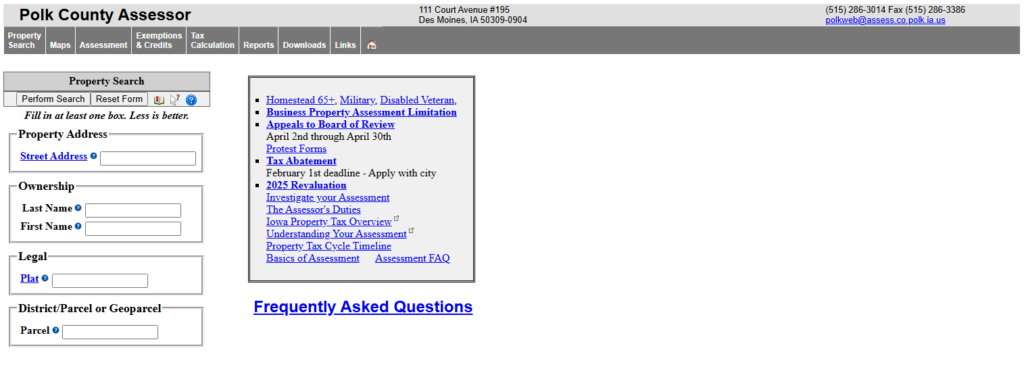
Property owners can expect a consistent process of assessment, which includes inspections, reviewing sales data, and applying standard appraisal methods. The office also addresses changes such as new construction, renovations, or property transfers. This ensures that taxable property values are up to date and equitable for all taxpayers.
Property Categories and Assessment Responsibilities
| Property Type | Assessment Responsibility |
|---|---|
| Residential | Single-family homes, condos, townhouses |
| Commercial | Office buildings, retail spaces, warehouses |
| Agricultural | Farms, cropland, pasture |
| Industrial | Factories, manufacturing facilities |
| Vacant Land | Undeveloped parcels, lots |
| Multi-family | Apartment buildings, duplexes |
The assessor’s office also handles exemptions, corrections, and appeals, making sure each property is fairly represented in the tax system. By maintaining accurate property records and fair valuations, the Polk County Assessor helps support the county’s budget and public services.
Assessment Calendar & Key Dates
Property owners in Polk County should monitor the assessment calendar to track deadlines for valuation notices, informal reviews, and protests. The Iowa Polk County Assessor’s office provides a clear schedule each year to help owners prepare and respond promptly.
Annual Assessment Timeline
The Polk County Assessor follows a structured assessment cycle each year. Property valuations are reviewed annually, and notices are typically mailed to owners in March. These valuation notices outline the assessed value of each property, including land and improvements. Owners can then review the notice and, if necessary, request an informal review to address discrepancies or provide supporting documentation.
Dates include:
- March: Mailing of valuation notices
- April–May: Informal review period for property owners
- June: Official protest period begins for formal appeals
- July: Deadline to file protests with the Board of Review
- October: Board of Review decisions are finalized
Property owners are encouraged to keep track of these deadlines to avoid missing opportunities to contest valuations.
How Property Values Are Determined
Property values in Polk County are set by the Polk County, Iowa Assessor based on market trends, property features, and local appraisal standards. These values reflect what a property would likely sell for under normal market conditions. The Polk County, Iowa, Assessor uses a combination of appraisal methods to determine accurate property values.
The three main approaches include:
- https://www.assess.co.polk.ia.us/cgi-bin/web/tt/infoqry.cgi?tt=aboutus/market
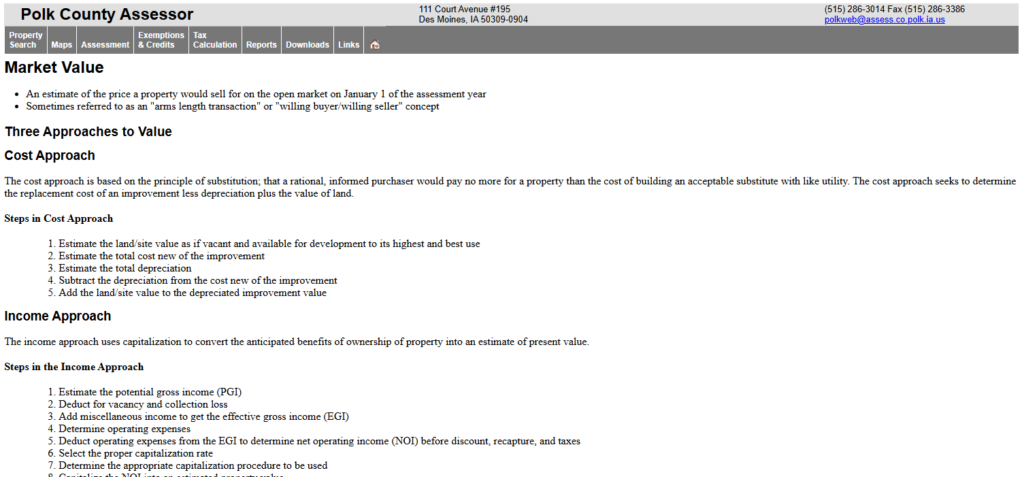
- Sales Comparison Approach: Compares a property to similar homes recently sold in the area. For example, a 3-bedroom home in Des Moines may be valued by examining recent sales of comparable properties nearby.
- Cost Approach: Calculates what it would cost to rebuild the property, accounting for depreciation. This method is commonly used for newer constructions.
- Income Approach: Applies mostly to rental or commercial properties, using income potential to estimate market value.
Agricultural and Special Property Adjustments
For agricultural land, the assessor considers soil quality, crop yield potential, and current market conditions. Adjustments may also reflect improvements like irrigation or fencing. This ensures that farmland and other special-use properties are assessed fairly compared to standard residential or commercial properties.
Sales Ratio and Equalization
Polk County regularly performs sales ratio studies to compare assessed values with actual sale prices. A consistent ratio across neighborhoods confirms assessments are accurate and equitable. If discrepancies appear, the assessor may apply equalization adjustments to balance property values across the county.
- Mini-case example: A residential home in West Des Moines sold for $220,000 while its assessed value was $215,000. The 97.7% sales ratio indicates a close match, confirming that the assessor’s valuation aligns with the local market.
By combining these methods and checks, the Polk County, Iowa Assessor ensures property values are fair, consistent, and reflective of true market conditions. Regular updates and analysis help maintain transparency and accuracy in the assessment process.
Investigating Your Parcel
Finding detailed information about a property in Polk County begins with the Polk County Assessor Iowa. Using the assessor’s tools, residents can quickly verify parcel data, review property records, and understand mapped contexts for their land.
Start with a Parcel Search
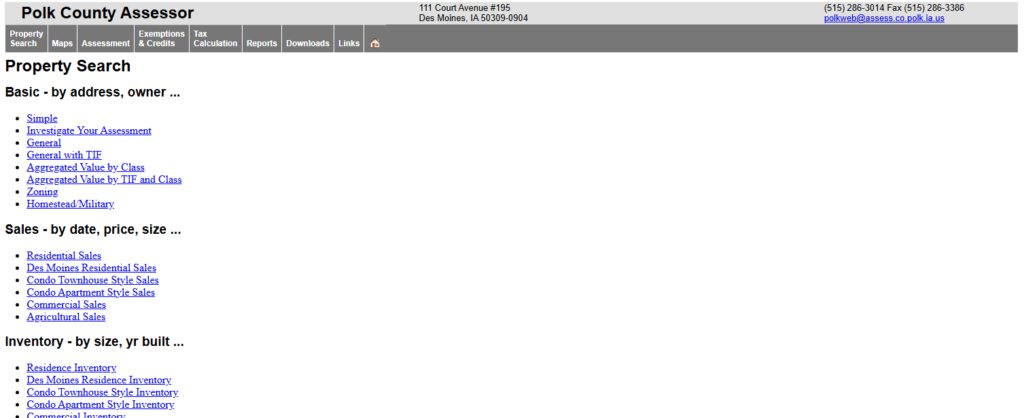
The Polk County Assessor’s website offers a parcel search tool to locate property details efficiently. Users can enter an address, owner name, or parcel number to retrieve records. Each search returns:
- Property ID and legal description
- Assessed value and tax information
- Zoning and land use data
This initial step ensures users are looking at the correct property and provides the foundation for deeper investigation.
Examine Property Records
After identifying the parcel, residents can review its property record for more precise information. Key details include:
- https://www.assess.co.polk.ia.us/cgi-bin/web/tt/info.cgi?tt=query/contents/queryforms
- Owner history and contact info
- Building specifications such as square footage and year built
- Lot size, boundaries, and improvements
Many records include mapped context, allowing users to visualize the property on an interactive map. This helps confirm lot lines, nearby streets, and neighboring parcels.
Verify Parcel Information
Verifying parcel details helps avoid errors in assessments or transactions. Users should compare digital records with:
- Recorded deeds and tax statements
- GIS maps for boundary accuracy
- Recent sales data for market trends
By following these steps, residents gain a clear, accurate picture of their property and its official records. The process combines parcel search, mapped context, and property history to ensure every detail is checked efficiently.
Exemptions, Credits & Special Programs
Polk County residents may qualify for several https://www.assess.co.polk.ia.us/cgi-bin/web/tt/info.cgi?tt=aboutus/exemptions property tax exemptions, credits, and special programs that reduce their tax burden. These benefits cover homeowners, veterans, businesses, and properties in revitalization areas.
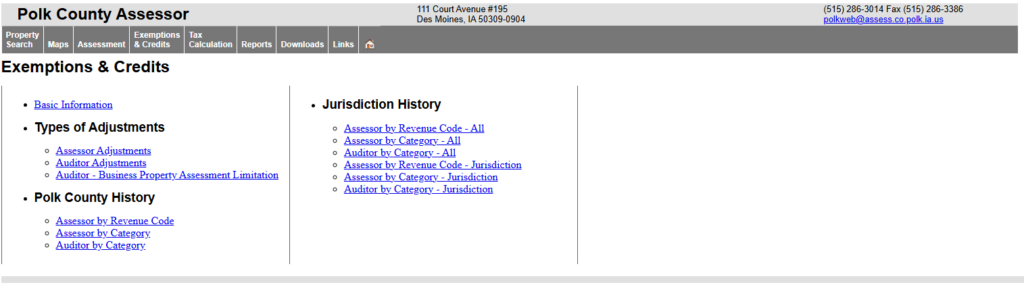
- Polk County Assessor’s Office:
- The Polk County Assessor’s Office offers a range of programs designed to ease property taxes for eligible residents. One of the most widely used is the homestead credit, which lowers taxes for primary homeowners based on property value. Property owners must submit the required forms by the annual deadline, usually in March, to qualify. Another key benefit is the military exemption, which provides partial or full relief for active-duty service members and their families. Disabled veterans may also be eligible for special exemptions that reduce their assessed value, helping lower tax bills.
- Business and urban incentives:
- Business and urban incentives support economic growth. The business property limitation restricts taxable value increases for certain commercial properties, giving local businesses some predictability in taxes. For urban development, the urban revitalization program and tax abatement initiatives encourage property improvements in designated areas. Eligible property owners receive reduced assessments for a defined number of years. These programs have specific criteria, including property type, improvement scope, and location within Polk County.
| Program | Eligibility | Benefits | Application Notes |
|---|---|---|---|
| Homestead Credit | Primary homeowners | Reduces taxable value | Apply annually with form A-42 |
| Military Exemption | Active-duty military, veterans | Partial/full tax relief | Submit DD-214 or active-duty proof |
| Disabled Veteran | Qualified veterans with service-related disability | Tax reduction based on property value | Annual renewal may be required |
| Business Property Limitation | Commercial property owners | Local assessor coordinates the application | File valuation forms by April 1 |
| Urban Revitalization | Properties in designated urban zones | Reduced assessment for improvements | Approval through city planning office |
| Tax Abatement | Renovation or new development projects | Temporary tax reduction | Approval through the city planning office |
Forms for these programs are available directly from the Polk County Assessor’s Office, and residents are encouraged to review eligibility requirements early. Applying on time ensures the benefits apply to the current tax year. Property owners can also contact the assessor’s office for guidance on which programs may apply to their property.
Requesting an Informal Review
Residents of Polk County can request an informal review from the Assessor’s Office if they believe their property assessment is inaccurate. This process allows property owners to present supporting evidence and potentially adjust their assessed value without filing a formal appeal. An informal review is a simple and effective way to question a property’s assessed value. Property owners should start by checking the review window, which typically opens shortly after the annual assessment notices are mailed. Acting promptly ensures all deadlines are met, and your case is considered on time.
Steps Process for an Informal Review
- Gather Documentation: Collect recent appraisals, comparable sales, and property records. Include photos of any damage or issues that could affect value.
- Complete the Request Form: The Polk County Assessor’s Office provides a form for informal review requests. Fill it out with accurate property details and a clear statement of your concern.
- Submit Supporting Evidence: Attach all relevant documentation and evidence to strengthen your request. Well-organized evidence increases the chances of a favorable outcome.
- Schedule a Review Meeting: The Assessor’s Office may offer a brief meeting or phone consultation. Be prepared to discuss your property and explain your evidence concisely.
- Receive the Outcome: After reviewing the information, the Assessor will notify you of any adjustment. If the outcome is unsatisfactory, property owners can still pursue a formal appeal.
Filing a Protest with the Board of Review
Property owners in Polk County can file a protest with the Board of Review if they believe their property assessment is incorrect. This process allows taxpayers to challenge valuations, exemptions, or classifications that may cause overpayment of taxes.
Grounds for Filing a Polk County Assessor Protest
The Polk County Assessor’s Office recognizes several valid reasons for a protest:
- https://www.assess.co.polk.ia.us/cgi-bin/web/tt/infoqry.cgi?tt=aboutus/protest
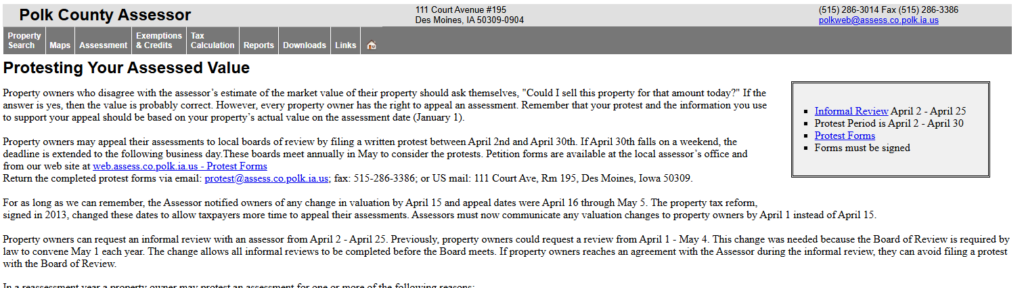
- Overvaluation: The property’s assessed value is higher than its market value.
- Inequity: Similar properties are assessed differently, creating an unfair tax burden.
- Exemption or Misclassification: Errors in applying exemptions or incorrect property type classifications.
- Error or Fraud: Mistakes in property details, ownership, or valuation that affect the assessment.
Each of these grounds is legally recognized under the Iowa Code, and property owners must clearly specify their reason when submitting a protest.
Filing Deadlines and Required Forms
To submit a protest, property owners must adhere to strict deadlines set by the Board of Review. Typically, protests are due within 30 days of receiving the assessment notice. Polk County provides official protest forms that must be completed accurately. Forms can be requested from the Assessor’s Office or downloaded from the county website.
Requirements for forms include:
- Property identification and parcel number
- Owner’s contact information
- Specific grounds for the protest
- Supporting evidence such as appraisals, sales data, or error documentation
Preparing Evidence and Attending an Oral Hearing
An effective protest relies on clear evidence. Property owners are encouraged to compile all relevant documents that support their claim. Examples include:
- Recent property appraisals
- Comparable sales in the neighborhood
- Photographs showing property defects or condition issues
- Records indicating classification or exemption errors
After filing, the Board of Review may schedule an oral hearing where owners can present their case in person. During the hearing, the board reviews evidence, asks questions, and may consult the Assessor’s Office for additional details.
Appeals Beyond the Board of Review
Property owners in Polk County who are unsatisfied with the Board of Review’s decision can take their appeal further through the Property Assessment Appeal Board (PAAB) or directly to the district court. These options provide structured ways to challenge assessment values and seek fair consideration.
Property Assessment Appeal Board (PAAB) Process
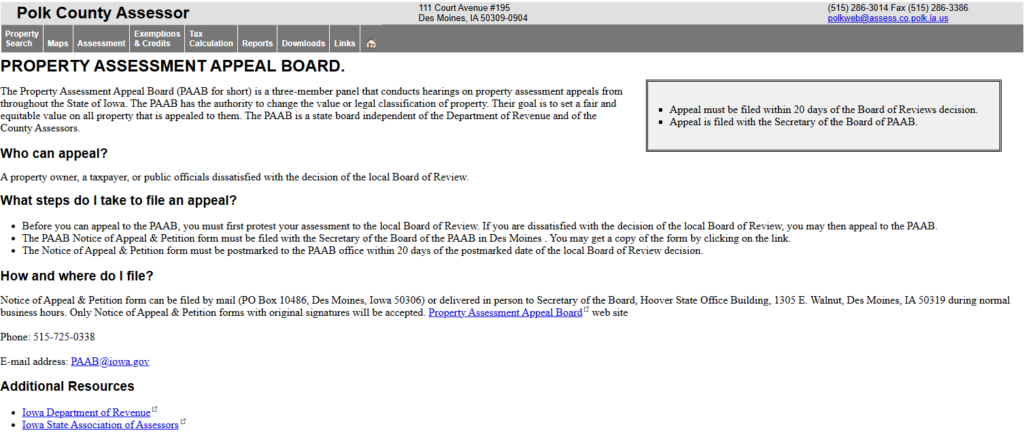
The PAAB is an independent state-level board that hears appeals after the local Board of Review has issued its decision. Property owners must file within 30 days of the Board’s final ruling.
When preparing a PAAB appeal, it’s helpful to:
- https://www.assess.co.polk.ia.us/cgi-bin/web/tt/infoqry.cgi?tt=aboutus/paab
- Gather supporting documents such as recent appraisals, sales data, and photographs.
- Include the Board of Review’s decision and any correspondence related to the property assessment.
- Clearly state the requested change and explain why the assessment may be inaccurate.
PAAB hearings are conducted in writing or in person, depending on the case type. The board reviews all evidence and issues an equalization order, which can adjust property values if justified.
Taking Appeals to the District Court
If a property owner disagrees with the PAAB’s decision, the district court offers a further path. Key points to keep in mind:
- File a petition within 30 days after the PAAB ruling.
- Be prepared to provide detailed documentation and expert testimony if available.
- The court can review procedural fairness, valuation methods, and comparables used in the assessment.
Many property owners find that legal advice or consultation with a real estate professional strengthens their case in court.
Owner’s Checklist for Assessment & Appeals
Property owners in Polk County can use a structured checklist to manage assessments and appeals efficiently. Following clear steps before, during, and after receiving your assessment notice ensures accurate property valuation and proper documentation for any disputes. The Polk County Assessor Owner Checklist helps property owners stay organized and confident throughout the process. It covers pre-assessment preparation, post-notice review, protest submission, and appeal actions, offering a step-by-step approach to reduce errors and improve outcomes.
Pre-Assessment Preparation
Before the official assessment, owners should gather and review all relevant property information. This includes:
- Property records: Current deeds, parcel numbers, and ownership details.
- Recent improvements: Receipts, permits, and photos of renovations or additions.
- Comparable properties: Sales data for similar homes in your neighborhood.
- Documentation of unique features: Any conditions affecting property value, like flood zones or historical designations.
Having these materials ready helps owners respond quickly if questions arise during assessment.
Post-Notice Review
After receiving the assessment notice, owners should carefully evaluate the details:
- Check accuracy: Confirm square footage, lot size, and structural information.
- Review assessed value: Compare with market trends and local property sales.
- Document discrepancies: Note errors or unusual changes compared to prior years.
- Prepare evidence: Collect photos, appraisals, or inspection reports supporting your valuation.
This step ensures that any errors are caught early and supported by concrete evidence.
Protest and Appeal Steps
If the owner disagrees with the assessed value, the next steps involve a formal protest and potential appeal:
| Step | Action | Details |
|---|---|---|
| File Protest | Submit a written protest to the Polk County Assessor | Include property info, reason for dispute, and supporting documents |
| Attend Hearing | Schedule a hearing with the Assessment Review Board | Present evidence, answer questions, and request review of comparable sales |
| Decision Review | Receive official determination | The board may adjust, confirm, or reject your assessment |
| Further Appeal | Present evidence, answer questions, and request a review of comparable sales | Must follow Iowa property tax law deadlines and procedures |
Assessment vs. Taxes
The Polk County Assessor sets a property’s assessed value, which determines the amount owed in property taxes. Higher assessed values usually lead to higher tax bills, but other factors like tax levies and rollback rates also play a role. Property assessment is the process of determining a home or land’s taxable value. This value reflects what the property would likely sell for under normal market conditions. Polk County uses these assessments to calculate property taxes, but the assessed value is just one part of the final bill.
How Taxes Are Calculated
Once the assessor assigns a value, the taxable value is adjusted using factors like:
- Rollback rates: These reduce the assessed value for residential or agricultural properties.
- Tax levies: Set by local governments, schools, and other agencies.
- Exemptions or credits: Certain homeowners may qualify for reductions based on age, disability, or veteran status.
For example, a home with an assessed value of $200,000 might have a rollback of 55%, lowering its taxable value to $110,000. The final tax bill is then calculated by multiplying this taxable value by the combined tax levies.
Departments & Contacts
The Polk County, Iowa Assessor Office departments & contacts provide clear ways to reach team members who handle property values, parcel records, exemptions, and related services. A contact list with office address, phone numbers, and email helps residents and property owners connect with the right assessor staff quickly. Below is information on key Polk County Assessor contacts and basic office hours. The main office for the Polk County Assessor is in Des Moines, IA, where property assessment questions, valuation issues, and exemptions are handled. Core contact details include a street address, phone numbers, and official email so users can reach staff directly and find official resources.
Polk County Assessor Contacts & Hours
| Department / Role | Contact Info | Hours |
|---|---|---|
| Main Office (Assessor) | 111 Court Avenue, Rm 195, Des Moines, IA 50309‑0904 | Mon–Fri: 8 AM–5 PM (call to confirm) |
| Phone | (515) 286‑3014 | |
| Fax | (515) 286‑3386 | |
| General Office Email | polkweb@assess.co.polk.ia.us | |
| Assessor – Randy Ripperger, CAE | same phone & email above | |
| Chief Deputy Assessor | Contact via the main phone | |
| Deputy Assessors | Available through the main number | |
| Property Questions & Records | Available through main number |
Polk County Assessor FAQs
The Polk County Assessor’s Office provides property owners with clear answers about assessments, exemptions, and appeal procedures. Residents can easily access information on parcel searches, informal reviews, and filing protests to address concerns about their property values.
How Can Residents Search for Property Parcels?
Property owners can use the online parcel search to find details about assessed values, ownership history, and land characteristics. Searches can be done by address, owner name, or parcel ID, showing building size, lot dimensions, and tax classification. The tool helps residents track property changes and plan for upcoming assessments. Regular checks also help ensure accurate records.
What Exemptions Are Available?
The Assessor’s Office provides exemptions that reduce taxable value for eligible property owners. These include the Homestead Credit for primary residences, elderly or disabled exemptions, and exemptions for agricultural or historic properties. Applicants must submit supporting documents by the annual deadline. Staff assists residents in determining eligibility and completing forms.
How Does an Informal Review Work?
An informal review allows owners to discuss valuation concerns directly with Assessor staff before filing a formal protest. Property owners can present evidence such as recent sales, repair costs, or appraisal reports. Adjustments may be made based on this information, potentially avoiding a formal protest. Reviews are usually completed within a few weeks.
What Are the Steps to Protest a Property Assessment?
If a valuation dispute remains after an informal review, owners can file a formal protest. This involves submitting a protest form, providing supporting evidence, and attending a hearing with the Board of Review. Decisions are communicated after review. Meeting deadlines and providing complete documentation ensures proper consideration of the case.
How Long Do Appeals and Reviews Take?
Timelines vary depending on the type of review. Informal reviews generally conclude within a few weeks, while formal Board of Review hearings may take longer. Property owners are encouraged to submit evidence early to prevent delays. Monitoring timelines helps owners plan for taxes and potential adjustments.