A Polk County property search tool allows the public to review parcel data, ownership details, assessment values, and tax records linked to land or buildings in Polk County, Iowa. The polk county assessor property search Iowa database lists parcel numbers, recorded ownership, property classifications, and GIS parcel maps connected with each property. Property search systems organize large county datasets into searchable records linked with each parcel location. Users can review land details, building information, and official assessment values tied to each property listing. Many records display sales dates, valuation history, and parcel boundaries connected with county GIS mapping systems.
County property databases collect verified property records, parcels lookup data, and real estate info from official offices such as the Polk County Assessor. These records show parcel identification numbers, ownership history, land value, building value, and tax assessment data tied to each property location. Public parcel search tools help buyers review property details before purchase, homeowners confirm valuation records, and researchers check real estate data across the county. GIS mapping layers display parcel boundaries, nearby lots, streets, zoning areas, and land layout. Search results often show sales history, property classification, and tax district details linked with each parcel record. This structured database connects maps, ownership records, and valuation data, so property information across Polk County remains organized, searchable, and easy to review.
What Polk County Property Search Includes
A Polk County property search provides detailed data from official county sources about land, buildings, and ownership. These Polk County property records show who owns a parcel, its assessed value, past sales, and key details stored in the county property database. Most county systems combine public land records, parcel identification numbers, tax assessments, and recorded documents in one place. This information helps residents, buyers, and property owners review property ownership records and check important property facts before making decisions.
Property Ownership Records
Property ownership records list the legal owner of a parcel registered in Polk County. These records come from deeds filed with the county recorder and appear in the public land records database.
Typical ownership details include:
- The owner’s name is listed on the property deed
- Mailing address for tax notices
- Date of ownership transfer
- Recorded deed reference number
Ownership records help confirm who holds legal rights to a property. They also help residents verify title history and identify ownership changes recorded in county files.
Parcel Numbers
Every property in the county receives a parcel identification number (PIN) used in the county property database. This number works like a tracking code that connects tax records, assessments, and mapping data.
Parcel details often include:
| Record Type | Description |
|---|---|
| Parcel Identification Number | Unique ID assigned by the assessor |
| Legal Description | Official description used in deeds and filings |
| Subdivision or Lot Info | Lot number, block number, or plat name |
| Property Map Location | Geographic location within Polk County |
Property Assessment Data
The Polk County Assessor’s Office maintains property assessment data for tax purposes. These records show how the county values land and structures each year.
Assessment files usually include:
- Assessed property value
- Land value and building value
- Property class
- Square footage and building characteristics
These details help property owners review valuation records used to calculate annual property taxes.
Real Estate Sales History
Sales history in Polk County property records shows past real estate transactions linked to a parcel. Each sale recorded in county files adds to the property’s transaction timeline.
Typical sales record details include:
- Sale date
- Sale price
- Document number recorded with the county
- Previous owner and new owner
Reviewing real estate sales history helps buyers compare market activity and track how ownership has changed across time. It also helps property owners confirm that past transactions appear correctly in the county property database.
How to Start a Polk County Property Search
A Polk County property search begins with basic property details such as an address, https://www.assess.co.polk.ia.us/cgi-bin/web/tt/info.cgi?tt=query/contents/queryforms owner name, or parcel number. Public databases in Polk County allow users to run a quick parcels lookup and review ownership, land details, and tax records in minutes.
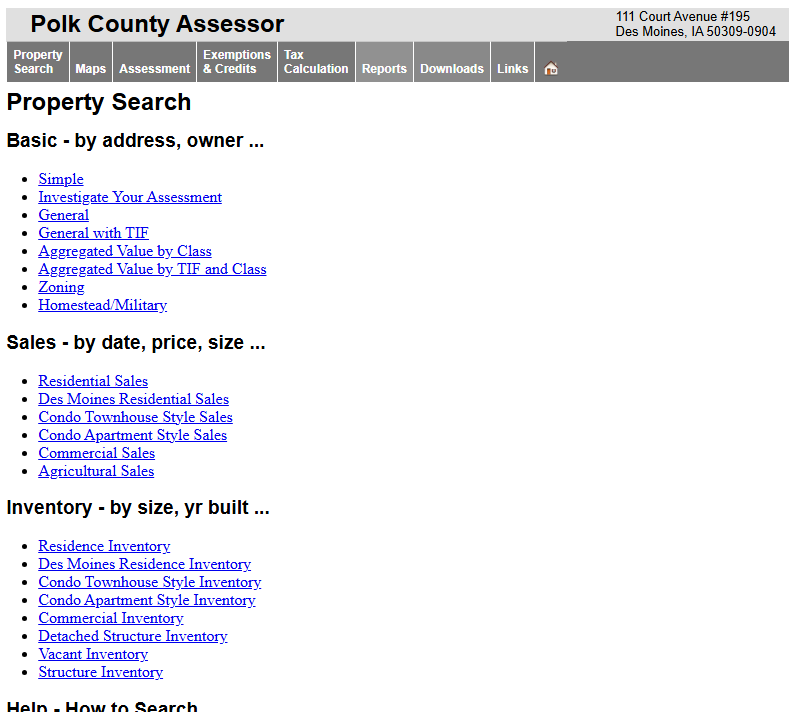
Property records in Polk County are stored in the county assessment and land record systems. These records support several search methods, so users can choose the option that fits the information they already have. Most searches start with simple identifiers like an address or parcel ID lookup, then display parcel boundaries, assessed value, sales history, and ownership data.
Common Polk County property search methods include:
| Search Method | Best Used When | Example Data Needed |
|---|---|---|
| Address Search | The exact property location is known | Street name and house number |
| Owner Name Search | Exact property location is known | Full or partial owner name |
| Parcel Number Search | Parcel ID already known | Parcel identification number |
| Legal Description | Title or deed records available | Lot, block, subdivision |
Each method connects to the same county parcel database. The difference lies in the starting information entered into the parcels lookup tool.
Search by Property Address
An address search remains the fastest way to locate property records. A user enters a street address, and the system returns parcel details tied to that location. Results often include land size, assessed value, tax district, and building characteristics. Map layers may appear at the same time, showing the parcel boundary and nearby lots.
Search by Owner Name
An owner name search helps locate property linked to a person or business. The search field accepts a full name or a partial name. For example, typing a last name may return several records. Each record lists the parcel number, mailing address, and property classification.
Search by Parcel Number
A parcel ID lookup offers precise results. Every parcel in Polk County receives a unique identification number from the county assessor. Entering that number returns a single record with ownership details, valuation history, and land information.
Polk County Assessor Property Search Tools
The Polk County Assessor’s Office provides several online search tools that help residents review assessor records and property valuation data. These tools allow users to explore the Polk County Assessor Property Search Iowa system and locate parcels within the official Polk County Assessor property database.b Property owners, buyers, and researchers often use these tools to review assessment roll data, confirm parcel information, and compare property values across neighborhoods. Each tool supports a different search style, ranging from quick lookups to advanced searches with district overlays.
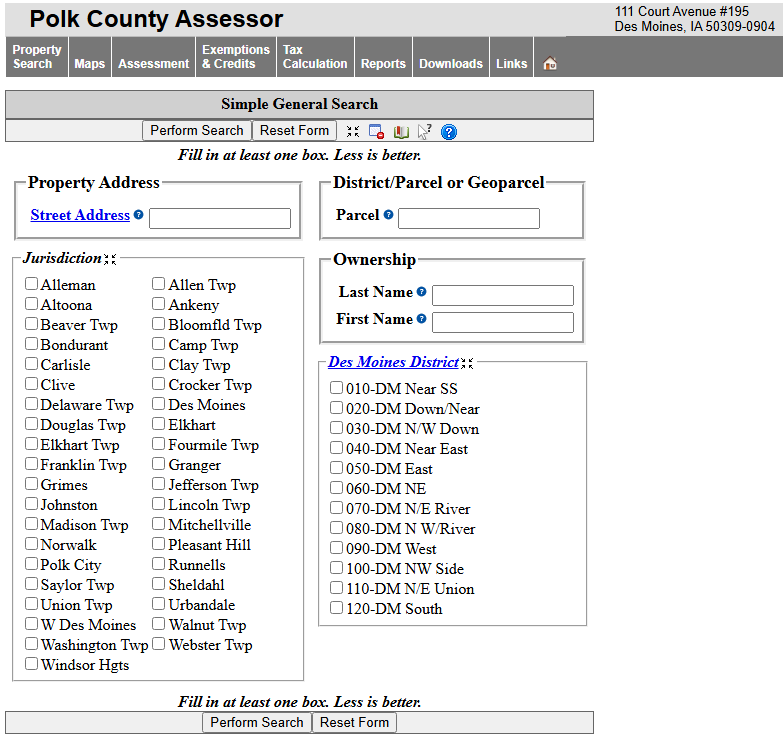
Simple Property Search Tool
The Simple Property Search Tool in the Polk County Assessor Property Search, Iowa system allows users to quickly locate parcel records inside the Polk County Assessor Property Database. A user can enter an owner name https://www.assess.co.polk.ia.us/cgi-bin/web/tt/form.cgi?tt=query/basic/simplegeneralform&help_state=1, property address, or parcel number to retrieve basic assessor records such as ownership details, parcel identification number, property class, and current assessed value listed in the county assessment roll. This quick lookup option works well for homeowners checking property details, buyers reviewing parcels before a purchase, and researchers verifying basic property valuation data.
Investigate Assessment Search
The Investigate Assessment Search tool focuses on detailed property valuation information. It shows how the county determines assessed value for taxation. Each parcel record breaks the total value into separate components. These figures appear in the county’s assessment roll, which lists every taxable parcel in Polk County.
Typical valuation sections include land value, building value, and total assessed value. Land value reflects the estimated price of the parcel itself, while building value represents the worth of structures placed on the land. Property records also show the property class, which identifies the category assigned to the parcel. Common examples include residential, commercial, agricultural, and industrial properties.
The table below shows the main valuation fields found in assessor records.
| Assessment Field | Explanation |
|---|---|
| Land Value | Estimated market value of the land |
| Building Value | Value assigned to improvements or structures |
| Total Assessed Value | Combined land and building value |
| Property Class | Category assigned for taxation |
Real estate professionals often review these details when comparing nearby properties. A higher building value may reflect newer construction or a larger living space.
General Property Search Form
The General Property Search Form supports deeper research within the Polk County assessor’s property database. It includes multiple filters that help narrow search results. Users may combine several fields during a search. A real estate analyst may look for residential parcels sold during a certain year, while a homeowner may search by subdivision name.
Common filters available in the form include:
- Owner name
- Street address
- Parcel identification number
- Property class
- Subdivision name
- Sale date range
Search results usually display a list of parcels matching the selected criteria. Each result links to a detailed property page that contains assessor records, building characteristics, and valuation history.
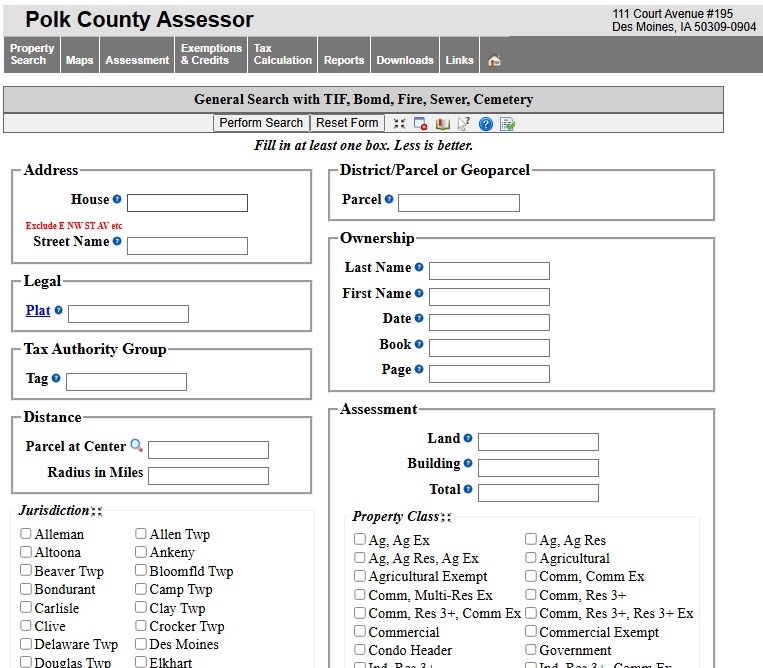
General Search With TIF Districts
The General Search With TIF Districts expands the standard Polk County Assessor property search iowa system by displaying parcels located within Tax Increment Financing (TIF) districts or special service districts. These overlays appear alongside normal assessor records and highlight properties that fall within redevelopment zones supported by tax increment financing programs. Property owners, investors, and planners often use this search option to review assessment roll changes, identify parcels within redevelopment areas, and evaluate how district designations influence local property valuation.
Using Polk County GIS Maps for Property Lookup
Polk County GIS maps help locate parcels, review property boundaries, and view land data in one interactive map system. The county’s geographic information system links parcels with ownership, zoning, and land features through an easy-to-use parcel viewer. The Polk County GIS platform lets property owners, buyers, and researchers explore land data visually. The map system connects tax parcels, land use layers, aerial imagery, and assessment details. Users can zoom into a parcel, check nearby lots, or review geographic layers such as zoning districts, soil types, and transportation routes.
The parcel viewer remains the central tool within the mapping platform. It displays parcel numbers, lot dimensions, and map overlays that clarify property boundaries. Users can search by address, owner name, or parcel identification number. After selecting a parcel, the map panel highlights the property and shows connected data panels with assessment records and land classification.
Typical map layers available in Polk County GIS include:
- Parcel boundaries
- Property ownership records
- Zoning and land use districts
- Aerial photography
- Road networks and utilities
- Floodplain and environmental data
These layers help users verify land characteristics before buying, building, or researching property history.
Parcel Boundary Maps
Parcel boundary maps display the exact outline of each property lot. The GIS map outlines each parcel with clear lines that match the official county parcel database. Property owners often use these maps to check lot size, property boundaries, and neighboring parcels. Real estate buyers often review these maps during due diligence. Boundary layers may include lot dimensions, parcel numbers, and adjacent property references.
For quick reference, the GIS map typically provides:
| Map Feature | Description |
|---|---|
| Parcel outline | Displays the legal lot boundary |
| Parcel ID | Unique identification number |
| Acreage data | Estimated land size |
| Neighboring parcels | Nearby property boundaries |
Neighborhood Mapping Tools
Neighborhood mapping tools display nearby parcels and land patterns across a wider area. The GIS interface allows users to zoom out and study several blocks or an entire district. This feature helps users compare nearby properties. Real estate professionals often review surrounding parcel sizes, street layouts, and nearby land use zones. Aerial imagery layers give a visual view of structures, roads, and landscape features.
Neighborhood maps often include overlays such as:
- Zoning districts
- School boundaries
- Transportation routes
- Public facilities
- Park and recreation areas
These layers give a clearer picture of local land planning and development patterns.
Drill-Down Parcel Maps
Drill-down parcel maps provide a deeper look at a selected parcel. After clicking a property in the GIS viewer, a detailed data panel opens with linked county records.
The map interface may display:
- Parcel identification number
- Property class and land use
- Building footprint layers
- Tax district information
- Sales history references
This drill-down view helps confirm parcel details before reviewing official assessment records or tax data.
Soil and Land Classification Maps
Soil and land classification maps highlight agricultural value, soil composition, and land capability. These layers help farmers, land planners, and property buyers review land productivity and development potential. Polk County GIS often connects soil layers from federal datasets such as the USDA soil surveys. Each soil type receives a classification that describes drainage, texture, and agricultural suitability.
Common soil map data includes:
- Soil classification codes
- Agricultural productivity ratings
- Drainage characteristics
- Land capability classes
These layers help evaluate farmland potential, erosion risk, and crop suitability across the county.
The Polk County Property Assessments
Property assessment in Polk County, Iowa, determines https://www.assess.co.polk.ia.us/cgi-bin/web/tt/form.cgi?tt=query/basic/extrageneralform the value of land and buildings for taxation. The assessed value helps local authorities calculate property taxes fairly for residential, commercial, and agricultural properties.
Property assessments in Polk County are conducted annually by the Assessor’s Office to ensure each property reflects its current market value. The assessed value is used to figure the taxable value, which is then multiplied by the rollback rate and the local tax rate to determine the final property taxes owed. Homeowners can check their assessment online, compare it with recent sales, and appeal if they believe the value is inaccurate.
Land Value vs Building Value
Polk County separates the value of land from the buildings or improvements on the property. Land value is based on location, size, and potential use, while building value considers construction type, age, condition, and square footage.
Points include:
- Land value increases with demand in growing neighborhoods.
- Building value may depreciate over time, but it can rise with renovations.
- Total assessed value equals the sum of land and building values.
This distinction helps property owners understand why taxes may differ even between similar-sized lots with different structures.
Residential vs Commercial Classifications
Properties in Polk County fall into different classifications: residential, commercial, and sometimes industrial. Residential properties include single-family homes, condos, and apartments, while commercial properties cover retail, office, and rental spaces.
Classification affects tax rates because:
- Residential properties often benefit from lower rollback rates.
- Commercial properties usually face higher tax rates reflecting their business use.
- Accurate classification ensures each property pays its fair share of taxes.
Agricultural Property Assessments
Agricultural properties are assessed differently in Polk County. The market value is replaced with productivity-based values, which reflect soil quality, crop yield potential, and acreage.
Important aspects:
- Agricultural land uses productive soil value rather than sale price.
- Farm buildings and barns are assessed separately.
- Owners may qualify for special exemptions or reduced rollback rates.
These categories allow Polk County property owners to interpret their tax statements accurately and make informed decisions about appeals or improvements.
Finding Property Sales and Market Data
Polk County property sales provide a clear picture of current market trends and transaction history. Both buyers and sellers can use this information to assess property value and compare recent sales in the area.
Tracking property sales in Polk County allows users to evaluate pricing trends and make informed decisions. Residential, commercial, and agricultural transactions each offer different insights into local market behavior. By reviewing comparable sales and market analysis, residents can understand how factors like location, size, and property type affect pricing. Accessing transaction history shows patterns in property turnover, helping predict future demand.
Residential Sales Records
Residential sales in Polk County cover single-family homes, townhouses, and condominiums. Users can find details such as:
- Sale price and date
- Parcel size and lot features
- Property type and number of bedrooms/bathrooms
- Nearby comparable sales for valuation
Recent data indicate that neighborhoods near Des Moines see higher turnover, with prices reflecting proximity to schools, parks, and transportation. Reviewing these records helps buyers identify trends and sellers set competitive asking prices.
Commercial Property Sales
Commercial property sales highlight investment opportunities and business growth areas. Polk County commercial records often include:
- Office buildings, retail spaces, and warehouses
- Lease and sale transaction history
- Market trends for commercial rental rates
These records help investors analyze potential returns and assess local business demand. For example, areas near major highways like I-35 and I-80 consistently attract retail and office developments.
Agricultural Land Sales
Agricultural land sales show trends in farm property value and land use in Polk County. Key information includes:
- Acreage, soil quality, and irrigation availability
- Crop history and farming potential
- Comparable farm sales and recent transactions
Farms near central Iowa’s major transport routes often have higher value, reflecting both productivity and accessibility. Buyers and investors use these insights to gauge market strength and long-term property value.
Property Inventory Information for Polk County Parcels
Property inventory in Polk County provides a comprehensive overview of all parcels, including residential, commercial, and vacant land. Residents, investors, and professionals can review key details like building characteristics, year built, and living area to make informed decisions.
Polk County maintains detailed property records that track each parcel’s size, structure, and use. This information is essential for evaluating property value, planning improvements, or analyzing local market trends. The inventory includes parcel maps, ownership details, and transaction history, which can help identify opportunities for purchase or development. Users can access specific data about the building type, square footage, and age, offering a clear picture of the county’s property landscape.
Residential Inventory
Residential property records provide a snapshot of homes across Polk County. These records include year built, square footage, lot size, and structural details such as the number of bedrooms, bathrooms, and building style. Residents and buyers can compare properties based on these characteristics, making it easier to assess comparable sales and neighborhood trends.
Typical data includes:
- Single-family and multi-family homes
- Living area measurements and lot dimensions
- Building age and renovation history
Commercial Inventory
Commercial property records cover office buildings, retail spaces, and industrial parcels. These listings highlight building use, floor area, construction type, and occupancy status. Investors and business owners can analyze these records to evaluate market conditions, rental potential, and development prospects.
Vacant Land Records
Vacant land inventory provides details about undeveloped parcels, including acreage, zoning type, and location within Polk County. These records support planning, investment, and agricultural uses.
Information often includes:
- Parcel dimensions and boundaries
- Zoning restrictions
- Potential land use classifications
Maintaining an organized property inventory ensures stakeholders have accurate, up-to-date data on Polk County parcels, making property decisions clearer and more efficient.
How Property Taxes Connect to Property Search
Polk County property taxes directly impact property values and ownership costs, making them a key factor in any property search. Buyers and owners can use tax information to assess affordability and plan their budgets accurately.
Property taxes in Polk County are calculated based on three main components: assessment, tax rate, and the final bill. The assessment determines a property’s taxable value, which the Assessor’s Office updates annually. The tax rate, often expressed as levy rates, varies by tax district and is set to fund local services like schools, roads, and emergency services. Multiplying the assessed value by the applicable tax rate gives the preliminary tax amount, which becomes the final bill after any exemptions or credits are applied.
These connections can help property seekers compare different parcels effectively. For example:
- Residential property search: Higher assessed values or tax rates may influence monthly housing costs.
- Commercial properties: Tax liabilities can affect return on investment and operating budgets.
- Agricultural lands: Levy rates for farmland can differ significantly, impacting overall costs.
Polk County also offers a property tax estimator, a useful tool for quickly calculating expected taxes based on assessed values and local levy rates. Using this alongside property search data allows buyers and investors to make informed decisions and avoid surprises.
Takeaways:
| Component | Role in Property Tax Calculation |
|---|---|
| Assessment | Determines taxable value of property |
| Tax Rate | Set by local levy districts, varies by property type |
| Final Bill | Assessment × Tax Rate minus exemptions = amount due |
By considering assessment, levy rates, and final bills, property searches become more precise, helping users evaluate both price and long-term ownership costs.
Accessing Polk County Recorder Property Documents
Polk County residents can view recorded property documents through the Recorder’s Office, which maintains official records of real estate transactions. These records include deeds, title transfers, and mortgage filings that show legal ownership and financial obligations. The Polk County Recorder’s property records serve as a public archive for all real estate activities in the county. Deed records document the transfer of property from one owner to another, while title transfers confirm legal ownership changes. Mortgage filings provide details about liens or loans placed on properties, helping buyers and researchers verify financial responsibilities.
Property documents are organized by date, property address, or parcel number, making it easier to find specific transactions. Many records are available online through the Polk County Recorder’s official portal, allowing users to view document images, search for historical transactions, or verify ownership history.
Points about recorded documents include:
- Deeds: Show the grantor, grantee, and property description.
- Title transfers: Confirm legal ownership changes over time.
- Mortgage filings: Record financial obligations tied to a property.
- E-recording options: Some documents can be filed electronically for convenience.
These records provide transparency and help property owners, real estate professionals, and legal teams access accurate information for buying, selling, or researching property in Polk County.
Steps Property Research Workflow
Conducting a Polk County property search can be straightforward by following a clear workflow. Users can efficiently gather information by checking parcels, assessments, maps, sales, and deed records. A practical approach starts with searching the parcel number in the Polk County Assessor’s database. This identifies the property and its basic details, including ownership, size, and zoning. Once located, users can view the assessment to see current valuations, tax history, and improvement details, which helps gauge property value trends.
Next, the GIS map offers visual insights into property boundaries, nearby roads, and neighboring parcels. This spatial perspective aids in understanding the property’s location and surrounding features. Following that, analyzing recent sales and transaction history provides a benchmark for comparable properties, helping identify market patterns for residential, commercial, or agricultural real estate. Finally, confirming deed records ensures legal ownership is accurate and up to date. This step verifies any liens, easements, or past transfers that could affect the property. Combining these steps creates a reliable, stepwise process for Polk County property research, enabling informed decisions backed by accurate data.
Common Reasons to Use Polk County Property Search
Polk County Property Search is useful for anyone who needs accurate property details quickly. It helps buyers, sellers, and property owners verify ownership, check taxes, and evaluate land or homes efficiently. Many people use Polk County Property Search for real estate research. This tool allows users to examine residential, commercial, and agricultural properties in the area. Buyers can compare recent property sales and find comparable sales to make informed offers. Sellers and investors also review transaction history to understand market trends and set competitive prices.
Property owners often use it for ownership verification. Confirming legal ownership can prevent disputes, clarify boundaries, and support zoning verification or development planning. Those planning improvements can also check the valuation review and estimate tax amounts for budgeting purposes.
Some common scenarios for using Polk County Property Search include:
- Buying property – check sale history, parcel details, and assessed value.
- Researching land – analyze acreage, zoning, and past transactions.
- Valuation review – estimate market value for refinancing, insurance, or sale.
- Zoning verification – ensure intended use aligns with county regulations.
This resource streamlines property information, reduces guesswork, and provides clear data for real estate decisions. Local experts frequently rely on it to make accurate evaluations before buying, selling, or developing land.
Departments Related to Property Search
Polk County property searches are supported by several key offices that handle ownership, tax, and transaction records. The Assessor, Auditor, Treasurer, and Recorder each provide specific services critical to property management.
Assessor’s Office
The Assessor’s Office evaluates property values for tax purposes and provides detailed assessments and parcel maps. Residents can check property characteristics, valuation history, and any improvements that affect the assessed value. Access to this information helps with research on comparable sales and market trends.
Auditor’s Office
The Auditor’s Office maintains official public records related to real estate and elections. It ensures property tax calculations are correct and that ownership records are current. This office is also a resource for transaction histories and municipal records.
Treasurer’s Office
The Treasurer’s Office handles tax collection and maintains payment records. Property owners can review tax bills, payment history, and any delinquent taxes using online tools, which streamline property management and verification processes.
Recorder’s Office
The Recorder’s Office files and stores deeds, mortgages, liens, and other legal property documents. These records provide legal proof of ownership and document all property transfers, helping buyers, sellers, and researchers confirm property history.
Polk County Property Search FAQs
Polk County property searches are straightforward using the county’s online tools. Residents and professionals can access parcel information, tax records, and ownership details directly through official platforms.
How do I search for property in Polk County, Iowa?
To search for property in Polk County, users can visit the Polk County Assessor’s online property search portal. Searches can be done using owner names, addresses, or parcel numbers. The system provides property details such as assessed value, land size, improvements, and sale history. Many real estate professionals also use this database to generate property sales reports and compare recent transactions in the area.
What is a parcel number?
A parcel number is a unique identifier assigned to each property in Polk County. It works like an account number for property records and is essential when reviewing deeds, tax records, or property transfers. For example, using the parcel number ensures you retrieve the correct property assessment, especially in areas with similar addresses or subdivisions.
How accurate are property assessments?
Property assessments in Polk County are based on market data, comparable sales, and property characteristics. While assessments are regularly updated to reflect market trends, actual market values may vary slightly. The Assessor’s Office provides transparency by showing valuation details, so users can review how assessments were calculated.
Can I see the property tax history?
Yes, Polk County maintains property tax records online. Users can view past and current tax amounts, payment history, and any outstanding balances. This helps homeowners and potential buyers understand the financial obligations tied to a property and plan for future taxes accurately.
Where can I view GIS parcel maps?
The county offers GIS (Geographic Information System) maps to provide a visual layout of properties. These maps include parcel boundaries, zoning, and nearby infrastructure. GIS maps are particularly useful for residential, commercial, and agricultural property analysis, showing how properties relate to surrounding areas.